How a Civil Engineer Turned an Unfinished College Experiment into a Deep-Tech Startup
Stempack
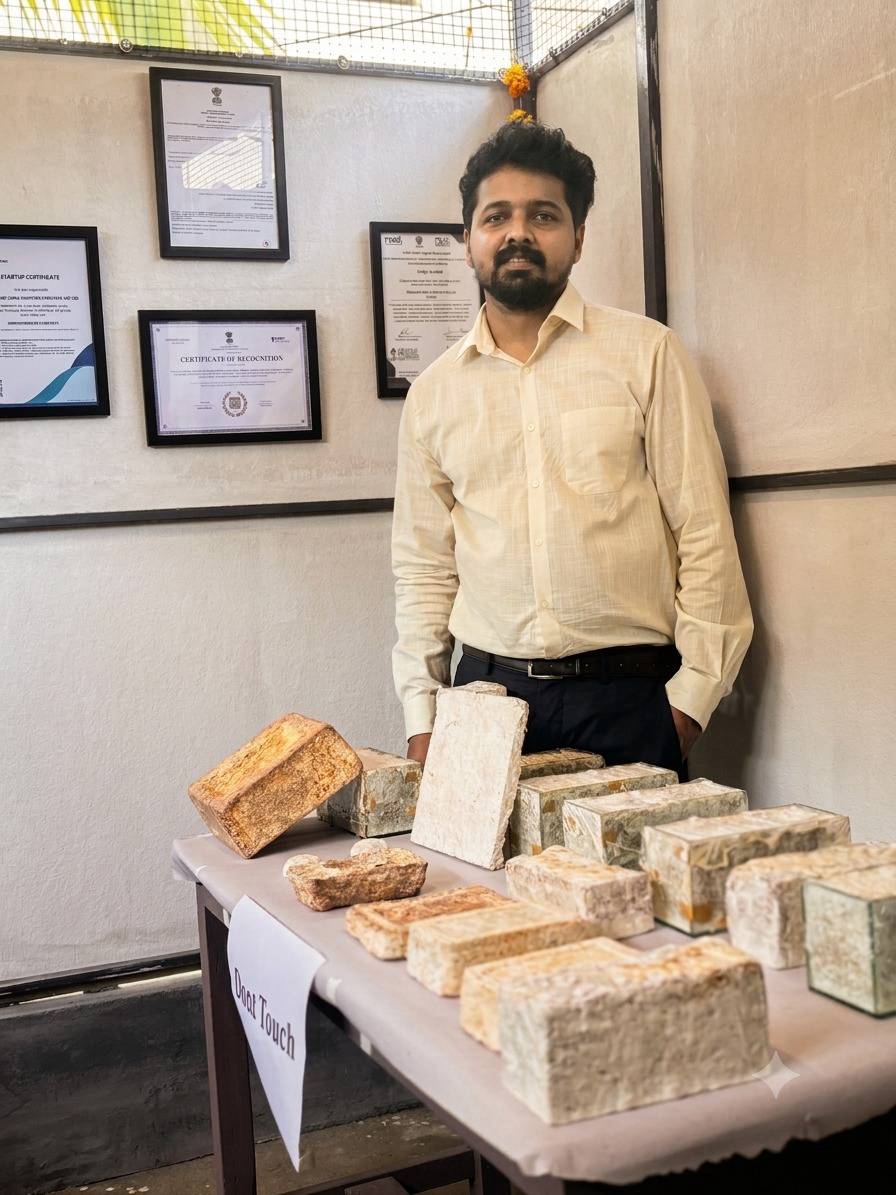
Some startup ideas are born out of market research. Others emerge from years of industry experience. Prageesh P.'s journey began with something he almost threw away.
In 2018, while pursuing his final year of Civil Engineering in Kollam, Kerala, he was experimenting with mushroom cultivation at home. Amid academic projects and deadlines, one mushroom spawn packet was forgotten in his backyard. By the time he opened it weeks later, it had rotted and smelled terrible. As he was about to discard it, something unusual caught his attention. The maize grains inside had fused into a single lightweight structure held together by a dense white network.
That white network was mycelium, the root structure of fungi.
What looked like a failed experiment became the beginning of an idea that would stay with him for the next seven years. If mycelium could naturally bind agricultural waste into a strong material, could it replace thermocol, one of the most widely used yet environmentally harmful packaging materials?
Driven by curiosity, Prageesh began experimenting with mycelium and agricultural fibres with the help of friends. Most attempts failed. Contamination ruined weeks of work, some samples lacked the required strength, while others failed to grow consistently. Unlike software startups where ideas can be tested within days, developing biological materials demanded patience. Every failed batch meant starting from scratch, often after waiting weeks for results.
One of his professors encouraged him to apply for a patent. The idea had potential, but the resources did not. Without access to a proper laboratory and the financial means to continue, the experiments came to a halt.
Life moved on.
Prageesh built a career as a structural engineer, but the unfinished idea quietly stayed with him. Every time he came across piles of discarded thermocol or plastic packaging, he found himself returning to the same question that had first surfaced in his backyard years earlier.
In 2025, he decided to stop postponing it.
That decision led to the formation of STEMPACK India Solutions Pvt. Ltd., a startup developing biodegradable protective packaging using mycelium and agricultural waste. The goal is to create sustainable alternatives to expanded polystyrene for electronics, consumer goods and industrial packaging while contributing to a circular economy.
Building the company, however, proved far more difficult than discovering the idea.
Unlike many startups that begin with laptops and software, STEMPACK required continuous experimentation, biological processes and physical infrastructure. Every improvement took weeks. Every contamination meant lost time. Developing a material that could consistently meet industrial standards required persistence more than speed.
Looking back, Prageesh believes the biggest obstacle wasn't technical. It was his own assumption. He believed that building a great product would naturally attract customers and investors. For a long time, almost all his attention went into research and product development. Customer conversations, networking and market validation came much later.
That decision cost him valuable time.
"I underestimated the importance of building relationships early," he says. "A startup doesn't succeed through innovation alone. It succeeds through execution, customer validation and trust."
The lesson changed the way he approached entrepreneurship. Today, he spends as much time speaking with mentors, incubators, industry experts and potential customers as he does improving the technology itself.
Other moments tested his confidence.
Explaining that he was trying to grow packaging from fungi often invited disbelief. Some people smiled politely, while others dismissed the idea altogether. Convincing people to believe in a material they had never seen was difficult, especially when he himself was still working to prove it at scale.
The turning point came when the first successful prototypes began taking shape.
Recognition soon followed. STEMPACK was recognised by Kerala Startup Mission and Startup India, received the KSUM Idea Grant, and gained support from Krishi Bhavan, Vilakkudy, and the Department of Industries and Commerce, Pathanapuram. For Prageesh, these milestones were more than achievements. They were reassurance that the years spent pursuing an unconventional idea had not been in vain.
Behind those milestones, however, is a reality that rarely appears in startup announcements.
Prageesh continues to work a full-time job while building STEMPACK.
Supporting his family remains a responsibility he cannot set aside, so the company has largely been built during evenings, weekends and holidays. Much of his personal savings has gone into experiments, prototypes and product development. Family gatherings, birthdays and celebrations have often been replaced by research, proposal writing and meetings.
One detail from his journey captures those early years better than any funding announcement ever could.
Without a dedicated laboratory, many of his prototypes were developed and stored inside his own home, sometimes even under his bed because there was simply nowhere else to keep them.
It is an image that contrasts sharply with the polished narratives often associated with deep-tech entrepreneurship. STEMPACK did not begin inside a sophisticated research facility. It began with limited resources, countless failed experiments and the determination to continue despite not knowing whether the effort would ever become a company.
What kept him going during those years was not validation.
It was conviction.
There were times when people questioned the idea and moments when support was difficult to find. Then he watched another Indian startup working on mycelium-based packaging appear on Shark Tank India. Rather than discouraging him, it reinforced his belief that the problem was worth solving.
"If someone else could build it," he remembers thinking, "why couldn't I?"
Today, STEMPACK is working towards completing product validation, establishing a pilot manufacturing facility and partnering with industries to test its packaging at a commercial scale. The immediate focus is not rapid growth but building a manufacturing process capable of replacing thermocol reliably across industries.
For Prageesh, the company has never been just about packaging.
It is about proving that meaningful deep-tech innovation can emerge from simple beginnings, even without sophisticated laboratories or abundant funding. Looking back, he hopes people remember that STEMPACK was built with whatever resources were available at the time, while balancing a full-time career, family responsibilities and years of uncertainty.